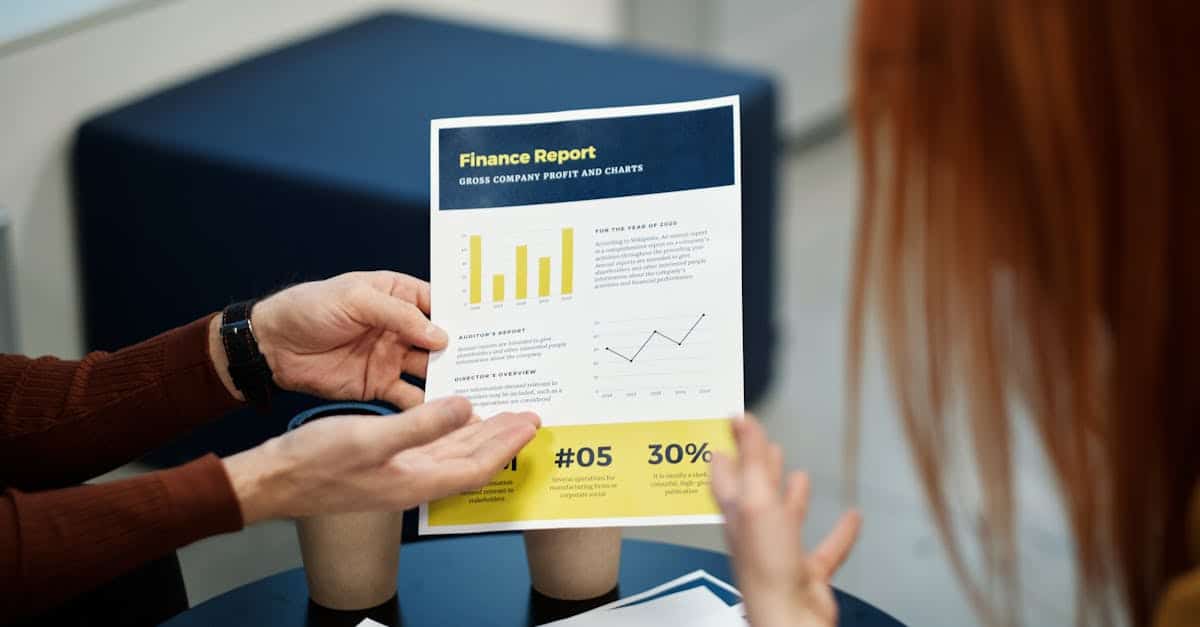
When a company presents its annual report and accounts to foreign investors, the quality of the translation is part of the document's credibility. A terminology error in a footnote or an inconsistency between the balance sheet and the management report can raise doubts that no investor presentation will resolve.
What separates financial translation from general translation
An annual report is a composite document. It contains financial statements with standardised terminology, explanatory notes with technical and legal language, and a management report written in narrative prose. Each section requires different handling, but the terminology must remain consistent throughout.
Financial translation requires knowledge of the applicable accounting standards. A Portuguese company reporting under NCRF (Portuguese national accounting standards) that wants to present its accounts to British or American investors needs a translator who understands both the Portuguese framework and IFRS or US GAAP conventions. Terms like "fair value", "impairment", and "revaluation surplus" have precise equivalents. Used incorrectly, they change the meaning.
Consistency across the balance sheet, income statement, cash flow statement, and notes is not optional. Auditors and analysts will notice any divergence. Professional financial translation starts with building or applying a company-specific glossary, which is maintained across reporting cycles.
Market-specific requirements
The target market determines not only the language but the presentation conventions and, in some cases, formal requirements.
United Kingdom and Ireland: Institutional investors expect terminology aligned with IFRS as adopted in the UK post-Brexit. The labelling of balance sheet line items and the structure of the notes should reflect that framework, even if the source document follows Portuguese NCRF.
United States: If the company has relationships with US investors or partners, a translation oriented towards US GAAP is worth considering, or at minimum one that includes reconciliation notes where differences are material. American English has its own conventions for number presentation: comma as thousands separator, full stop as decimal marker.
Germany, France, and other European markets: Translation into German or French must account for local accounting terminology. "Goodwill" does not translate identically under German HGB and under IFRS as applied by listed groups.
Angola and Mozambique: Companies with operations in Lusophone African markets may need versions adapted to the local regulatory context, where the accounting framework differs from the Portuguese one in several practical respects.
In any market, when the document is being submitted to a regulator or stock exchange, a certified or sworn translation may be required. The specific requirements should be confirmed with the recipient institution before the translation process begins. For companies considering capital markets activity, the process of translating prospectuses for international stock exchange listings follows a related but more tightly regulated path.
The translation process for an annual report
A Portuguese SME's annual report typically runs between 40 and 120 pages. For listed groups, it can exceed 300 pages. The process must accommodate that volume without compromising review quality.
The standard process follows ISO 17100, which requires translation by a qualified specialist and mandatory review by a second specialist. For financial documents, the review must be carried out by someone with sector knowledge, not only linguistic competence.
The practical steps are as follows:
- Document analysis: identifying sections, the applicable accounting framework, and the requirements of the target market.
- Glossary and translation memories: building or updating a company-specific glossary. Where previous translations exist, memories are reused to ensure consistency.
- Translation and review: the full TEP process (translation, editing, proofreading) in compliance with ISO 17100.
- Final quality control: checking terminological consistency, formatting, and correspondence with the source document.
- Certification (where required): for documents that need formal validation.
Timelines depend on volume and urgency. For an 80-page report under standard conditions, the delivery date is confirmed in the quote. For shorter deadlines, parallel teams can be organised, but feasibility should be confirmed before commitments are made to investors.
For a broader view of the document types and sectors covered under financial translation, the article on financial translation services provides useful context.
How M21Global supports companies through this process
M21Global has been working with Portuguese and international companies on the translation of annual reports and accounts since 2005. With ISO 17100:2015 certification from Bureau Veritas and over 445 million words translated, the company has specialist translators for financial documentation in English, French, German, Spanish, and other European and African languages.
The process includes company-specific glossary creation, translation memories maintained across annual editions, and review by specialists with proven experience in financial and accounting translation. Where certification is required, M21Global handles that step directly, without the need to involve a third party.
Request a quote for your annual report translation at m21global.com/en/services/financial-translation and receive a proposal with a detailed timeline and cost breakdown.
Related Services
Request a free financial translation quote
- Request a free financial translation quote
- Financial Translation Services
- Translating Prospectuses International Stock Exchange Listings
- Annual Reports And Accounts What You Need To Know
Frequently Asked Questions
Does an annual report translation need to be certified for foreign investors?
It depends on the market and purpose. For private institutional investors, a professional translation without certification is generally sufficient. For regulators, stock exchanges, or legal proceedings, a certified or sworn translation may be required. The specific requirements should be confirmed with the recipient institution.
How long does it take to translate an annual report?
For an 80-page report with the full ISO 17100 translation and review process, the timeline is confirmed in the quote. For tighter deadlines, parallel teams can be arranged, but feasibility should be confirmed case by case before committing to external timelines.
Which language pairs are most requested for annual report translation?
English is the most requested target language, followed by German and French, which correspond to the main European investment markets. For companies with African operations, English and French are also common for Angolan and Mozambican contexts.
How is terminological consistency maintained across annual editions?
Through company-specific glossaries and translation memories that are updated and reused with each new edition. This ensures that the same line items and financial concepts are translated identically year on year, which is essential for investor comparability.
What quality standard applies to financial translation?
ISO 17100:2015 sets the requirements for translation services, including translation by a qualified specialist and mandatory review by a second translator. For financial documents, it is advisable that both the translator and reviewer have training or demonstrable experience in finance or accounting.